Cover-ups
Not simply covered. Composed anew.
A convincing cover-up begins with analysis. Pigment density, line flow, body shape and open skin determine how the new composition can be built.

Planning before execution
Read the starting point.
Design the whole.
A cover-up is developed as one connected work. Existing structures can be covered, integrated or rebalanced with additional space. Size, contrast and placement follow from the starting point, not from a predefined motif size.
With complex cover-ups in particular, a strong solution needs trust. The more creative room the new composition is given, the more consistently it can reorder the old tattoo instead of merely reacting to it.
Not every starting point is suited to a strong cover-up. What counts is pigment density, size, placement, the condition of the skin and the willingness to give the new composition the room it needs.
We only take on work for which we can stand behind a convincing solution, both artistically and technically. If the starting point does not allow a strong composition, we say so clearly.
From assessment to work.
- 01
Personal conversation
We look at the existing tattoo, the part of the body and the direction you want. Before anything is designed, it must be clear what the starting point really allows.
- 02
Analysis of the starting point
Pigment density, line flow, body shape and available space define the creative scope. Possibilities and limits are named just as clearly.
- 03
Artistic composition
If the basis holds, the new overall composition is created. Scope, schedule and execution are only planned in binding terms after that.
Selected works
Cover-up compositions
Selected cover-up works from the atelier. Several views of the same project are grouped together. Every work can be enlarged.

More views 2

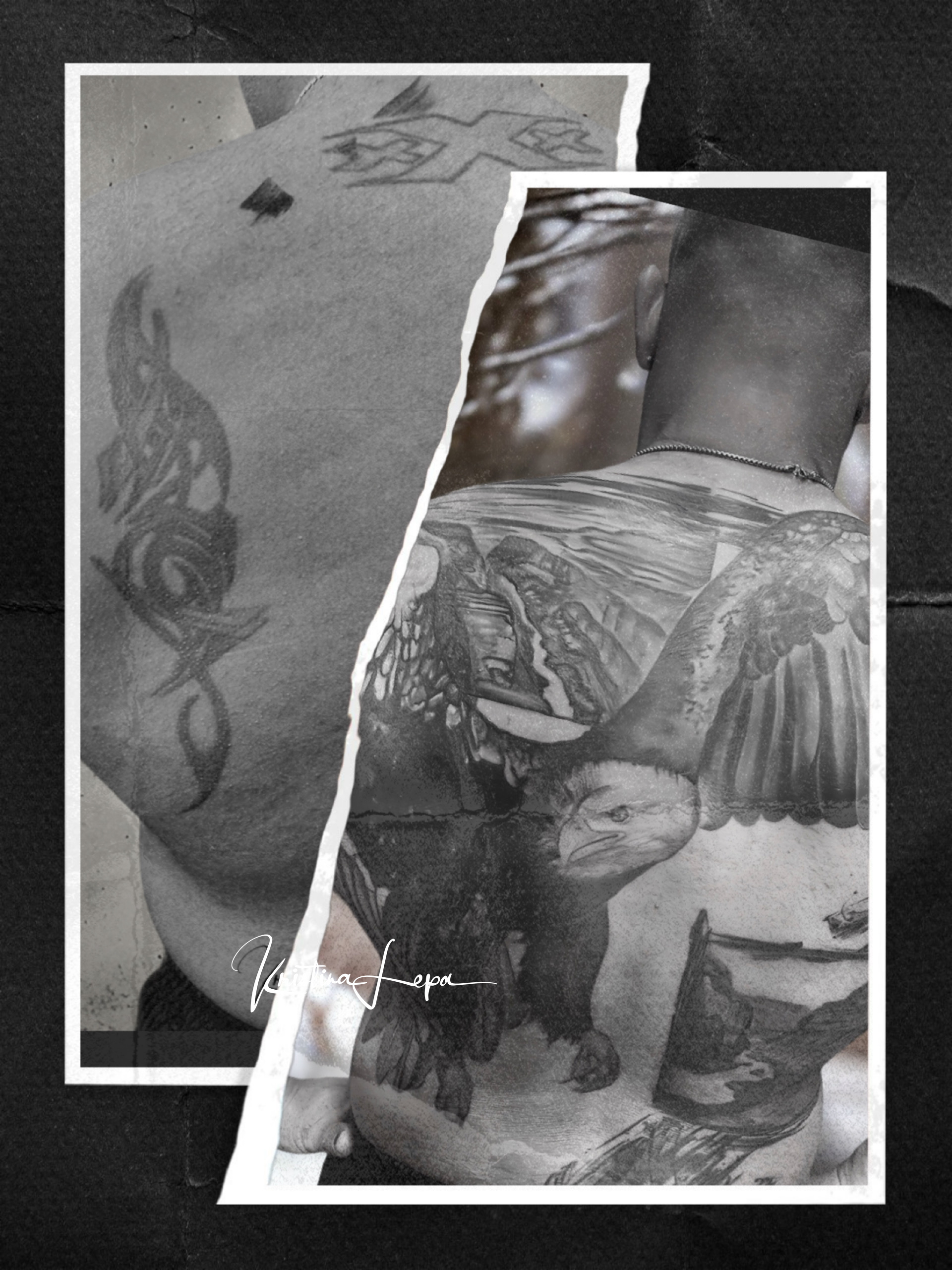

Another view 1


COVER-UP · ORIENTATION
What the starting point decides.
Is every tattoo suitable for a cover-up?
No. Pigment density, line flow, size, placement and the condition of the skin decide whether a strong design solution is possible. A binding assessment is made in person.
Does a cover-up have to be larger?
A cover-up often needs additional space and deliberately placed contrast. The scope that is needed follows from the starting point and is stated clearly before planning begins.
Is laser lightening always necessary?
No. Whether lightening makes sense for the direction you want depends on the starting point. We do not offer it; we assess only the artistic scope for the cover-up.
How does a cover-up project begin?
With a personal conversation and a professional assessment of the existing tattoo. If the basis holds, the artist develops an independent composition from it. The design is not taken from ready-made templates.
Will the old tattoo be completely invisible?
The aim is a composition in which the old tattoo is no longer read as a motif of its own. How far that succeeds depends on pigment density and line work. We say what is realistic before planning begins.
Does a cover-up have to be dark?
A cover-up needs contrast and depth, but not necessarily a black area. Shading, structure and deliberately placed open skin can bind the old work into a new composition.
How many sessions does a cover-up need?
That depends on size and density. Extensive cover-ups are usually created over several sessions. We name the expected scope after the assessment.
Other studios have turned my cover-up down. Is it worth asking?
Yes. A refusal often says more about how a studio works than about your starting point. We look at it without prejudice and say openly whether we see a convincing solution.
Can I send photos in advance?
Yes. You can send them by e-mail or WhatsApp. Photos give a first orientation; the binding assessment is made on the body.
What does a cover-up cost?
A cover-up is planned individually, so there are no flat prices. We discuss scope and fee before the work begins.